Cottage cheese has undergone a significant reassessment in nutrition-conscious eating, and for good reason. At roughly 14 grams of protein per half-cup (113g), it rivals Greek yogurt in protein density while offering a different texture — soft, slightly grainy, and mild — that many people find easier to eat in small quantities. For GLP-1 medication users, this texture distinction matters. On days when appetite is suppressed or nausea is present, foods that are cool, lightly seasoned, and require minimal chewing are far more manageable than heavier or more aromatic options.
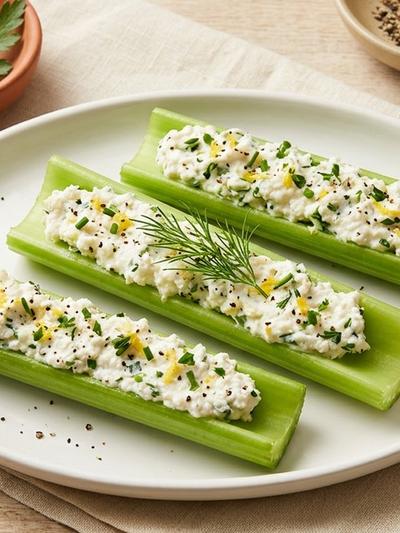
The cucumber boat format solves several problems at once. Cucumber provides a crisp, water-dense vessel that adds volume without calories — 100 grams of cucumber contains about 15 calories. Hollowing out the center removes the seed core, which holds excess moisture and can make the filling slide around. The result is a structured, two-bite snack that looks intentional on a plate, which can be a small but meaningful factor when appetite needs gentle encouragement.
The seasoning in this recipe — dill, lemon, and everything bagel seasoning — brightens what might otherwise be a bland combination. These flavors are light and herbal rather than rich or strong, which makes them appropriate for days when food sensitivity is elevated.
Why This Works on GLP-1
Cottage cheese is primarily composed of casein protein — the slower-digesting protein fraction of milk. Casein forms a gel in the stomach, which slows its own digestion and produces a sustained release of amino acids into the bloodstream over several hours. This slow-release characteristic complements the gastric-emptying slowdown caused by GLP-1 receptor agonists, meaning the satiety signal from a small serving can persist longer than the volume of food alone would suggest.
The caloric density here is notably low: approximately 120 calories for four boats. This is relevant for GLP-1 users — including those on Wegovy or Mounjaro — whose total daily caloric intake may be substantially lower than pre-medication baselines. Snacks that provide strong protein returns at low caloric cost allow more flexibility in daily eating patterns and reduce the risk of falling into a caloric deficit severe enough to compromise lean muscle mass.
Cucumber's high water content (about 95% water by weight) contributes to hydration — something GLP-1 users sometimes struggle with if reduced appetite suppresses not just food intake but fluid intake as well.
Ingredients (serves 1, makes 4 boats)
- 1 medium English cucumber (about 300g / 10.5 oz) — English or Persian cucumbers have thinner skins and fewer seeds
- ½ cup (113g / 4 oz) low-fat cottage cheese (2% milkfat)
- 1 tablespoon fresh dill, finely chopped (or ½ teaspoon dried dill)
- 1 teaspoon fresh lemon juice
- ¼ teaspoon lemon zest (optional but recommended)
- 1 teaspoon everything bagel seasoning
- Cracked black pepper, to taste
- Optional: 1–2 teaspoons capers, drained and roughly chopped, stirred into the cottage cheese
Instructions
Wash the cucumber and cut it in half crosswise, then cut each half lengthwise — giving you four pieces. Each piece should be roughly 7–8cm (3 inches) long.
Using a small spoon or a melon baller, scoop out the seed center of each piece to create a shallow trough. Remove just enough to make space for the filling — about 1cm (½ inch) deep. Do not scoop so deeply that you go through the bottom.
Pat the interior of each cucumber piece dry with a paper towel. Excess moisture from the seed core will thin the cottage cheese and make the boats watery.
In a small bowl, combine the cottage cheese, chopped dill, lemon juice, lemon zest, and black pepper. Stir gently — you want to incorporate the seasonings without completely mashing the cottage cheese curds, which gives the filling its texture.
Taste and adjust seasoning. The cottage cheese should be lightly bright with lemon and herbaceous from the dill. Add more lemon or dill if needed.
Using a small spoon, fill each cucumber boat generously with the cottage cheese mixture. Mound it slightly above the edges.
Sprinkle everything bagel seasoning across all four boats evenly. The sesame seeds, dried onion, and poppy seeds in the seasoning add both flavor and a small textural contrast.
Serve immediately, or cover and refrigerate for up to 2 hours before serving. Beyond 2 hours, the cucumber begins to soften and the filling weeps slightly.
Nutrition per Serving
Based on 4 boats with ½ cup cottage cheese filling:
- Calories: ~120
- Protein: ~15g
- Fat: ~2.5g
- Carbohydrates: ~8g
- Fiber: ~1g
Practical Notes
Choose full-fat or 2% cottage cheese depending on your needs. Full-fat cottage cheese has a creamier texture and higher fat content (~5g per serving), which increases satiety at the cost of about 30 additional calories. On days when nausea is low and hunger needs management, full-fat may be preferable. On high-nausea days, the lighter, less fatty 2% version is easier to tolerate.
Prepare the filling in advance, fill just before eating. The seasoned cottage cheese keeps refrigerated in a sealed container for 3–4 days. The cucumbers should be cut and filled as close to eating time as possible to maintain crispness. Keep both components separate until ready to eat.
Drain excess liquid from cottage cheese. Some brands of cottage cheese are quite wet. If your cottage cheese has visible liquid pooling in the container, spoon it into a fine mesh strainer for 5–10 minutes before seasoning. This prevents the filling from becoming watery in the boats.
The everything bagel seasoning is doing real work here. The combination of sesame, poppy seed, dried garlic, and dried onion adds complexity to an otherwise mild snack. If you don't have it, substitute with a pinch of garlic powder + sesame seeds + dried onion flakes.
Adjust portion size without guilt. Four boats is a single serving in this recipe, but on low-appetite days, one or two may be enough. This is fine. The goal is consistent protein exposure across the day, not hitting an arbitrary portion target in one sitting.
Cool temperature is a feature. For GLP-1 users experiencing warmth sensitivity or mild nausea, cold foods from the refrigerator are often better tolerated than foods at room temperature or warm. Cucumber boats served cold from the fridge can be a strategic choice on difficult days.
Frequently Asked Questions
Can I make these ahead and store them in the fridge?
I find cottage cheese grainy — is there a way to make it smoother?
What can I substitute for everything bagel seasoning?
Are these suitable when I'm experiencing nausea from my GLP-1 medication?
I can only eat 1 or 2 boats — is that still worth it nutritionally?
This article provides general food and nutrition guidance only. It does not constitute medical advice. Always consult your healthcare provider regarding your GLP-1 medication and individual nutritional needs.