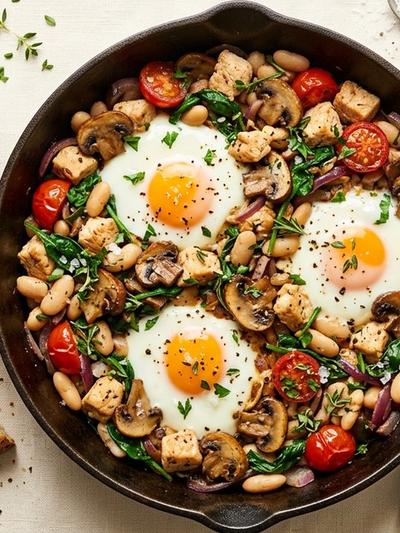
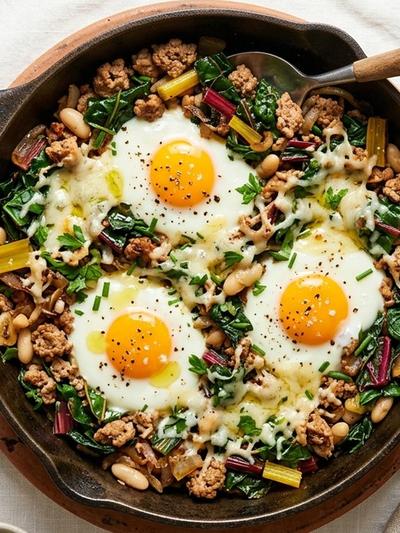
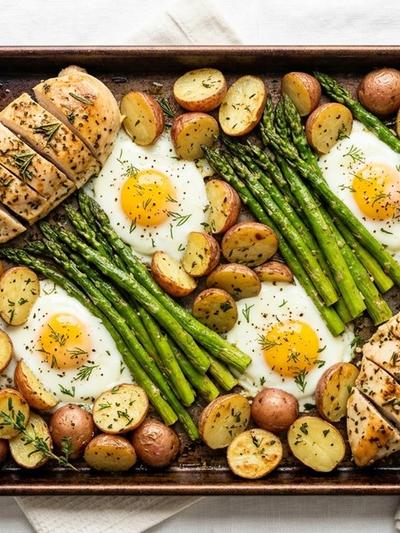
This Lyonnaise-style breakfast skillet packs 41 grams of protein per serving from a combination of lean chicken breast and whole eggs, all for under 400 calories. Sweet caramelized onions provide natural flavor depth without added sugar, while baby spinach adds iron and folate to round out the plate. The macros land at 15 grams of carbohydrates and 18 grams of fat, making this one of the most protein-efficient one-pan breakfasts you can make at home.
The defining feature is the onions. Slowly cooked until golden and jammy, they create a savory-sweet bed that transforms plain chicken and eggs into something worth getting out of bed for. A splash of white wine vinegar and a spoon of sharp Dijon mustard cut through the richness, and fresh thyme ties the French flavors together with an herbal warmth that feels distinctly Lyonnaise.
For GLP-1 users, this skillet works because the portions are concentrated rather than bulky. You get serious nutrition from a modest volume, so even on low-appetite mornings you can meet your protein goals in a few bites. The soft textures throughout — silky onions, tender chicken, runny-yolked eggs — are gentle on digestion and easy to eat slowly.
Why This Works on GLP-1
With 41 grams of protein packed into a single moderate serving, this breakfast directly addresses one of the most critical concerns during GLP-1-assisted weight loss: preserving lean muscle mass. Research consistently shows that people taking medications like Mounjaro can lose significant muscle along with fat when protein intake drops too low. This skillet makes it easy to hit your morning protein target in one sitting, even when appetite is reduced. The combination of chicken breast and whole eggs delivers a complete amino acid profile that supports muscle protein synthesis throughout the morning.
The slow-cooked onions in this dish offer a digestive advantage that raw onions cannot. Cooking breaks down the fructans that commonly cause bloating and gas, making caramelized onions much gentler on a GLP-1-slowed digestive system. The baby spinach adds a modest fiber boost and valuable micronutrients without contributing uncomfortable bulk, and the overall texture profile — soft eggs, tender chicken, silky onions — minimizes the mechanical work your stomach needs to do.
The moderate fat content of 18 grams per serving is deliberate. For people on Wegovy and similar GLP-1 medications who experience delayed gastric emptying, high-fat meals can sit in the stomach and intensify nausea, a common early side effect. This skillet keeps fat in a well-tolerated range while maximizing the protein-to-calorie ratio, a balance that most GLP-1 users find more comfortable than richer breakfast options like bacon-and-cheese scrambles.
Ingredients (serves 2)
For the skillet:
- 8 oz (225g) boneless, skinless chicken breast, cut into 1/2-inch dice
- 2 medium yellow onions, thinly sliced into half-moons (about 10 oz / 280g total)
- 4 large eggs
- 2 teaspoons olive oil
- 1 tablespoon Dijon mustard
- 1 tablespoon white wine vinegar
- 1 teaspoon fresh thyme leaves (or 1/2 teaspoon dried thyme)
- 2 cups (60g) baby spinach
- 1/4 teaspoon fine sea salt, plus more to taste
- 1/4 teaspoon freshly ground black pepper
For garnish:
- 2 tablespoons fresh chives, finely snipped
Instructions
Prepare the ingredients:
- Pat the chicken breast dry with paper towels and cut into 1/2-inch pieces. Season lightly with half of the salt and pepper and set aside.
- Peel and thinly slice the onions into half-moons. The thinner the slices, the faster and more evenly they will caramelize, so take your time here.
Build the skillet:
- Heat the olive oil in a 10-inch nonstick or well-seasoned skillet over medium heat until the oil shimmers.
- Add the sliced onions and the remaining salt. Stir to coat with oil, then let them cook for 12 to 15 minutes, stirring every 2 to 3 minutes. The onions will soften, release moisture, and gradually turn from white to a deep golden brown. If they start to darken too quickly or stick, reduce the heat slightly and add a tablespoon of water. Patience here builds all the flavor in the dish.
- Push the caramelized onions to the edges of the skillet, creating space in the center. Add the seasoned chicken pieces in a single layer and cook for 4 to 5 minutes, stirring once or twice, until the pieces are white throughout and lightly golden on the edges.
- Add the baby spinach and thyme, stirring everything together until the spinach fully wilts, about 1 minute.
- Stir in the Dijon mustard until evenly distributed through the chicken and onion mixture. The mustard adds savory depth and a subtle heat that ties the Lyonnaise flavors together.
Finish with eggs:
- Use the back of a spoon to make 4 shallow wells in the mixture. Crack one egg into each well.
- Cover the skillet with a lid or a large plate and reduce heat to medium-low. Cook for 3 to 4 minutes, until the egg whites are fully set but the yolks remain soft and runny. For firmer yolks, cook an additional 1 to 2 minutes.
- Remove from heat. Drizzle the white wine vinegar evenly over the skillet. The acidity lifts the caramelized onion sweetness and brightens every element. Top with the chopped chives.
- Divide between two plates, carefully lifting 2 eggs per serving with a spatula along with half the chicken and onion mixture.
Nutrition per Serving
| Nutrient | Amount (approx.) |
|---|---|
| Calories | ~390 kcal |
| Protein | ~41g |
| Fat | ~18g |
| Carbohydrates | ~15g |
| Fiber | ~3g |
Estimates based on USDA values for raw boneless skinless chicken breast, large eggs, yellow onions, olive oil, and baby spinach. Actual values may vary with ingredient brands and exact portions.
Practical Notes
If mornings are hectic, caramelize the onions ahead. The onions are the only time-consuming step, and they taste even better after a night in the refrigerator. Cook a double or triple batch on Sunday evening, store in an airtight container for up to 5 days, and reheat in the skillet before adding chicken and eggs. This cuts active morning cooking time to about 10 minutes.
Store leftover chicken-onion base without the eggs. The chicken and caramelized onion mixture refrigerates well for up to 3 days in a sealed container. Reheat it in the skillet and cook fresh eggs on top each morning, since reheated eggs lose their texture and appeal. This turns one cooking session into two or three quick breakfasts.
Swap chicken thighs if you prefer dark meat. Boneless, skinless thighs will add roughly 3 grams of fat and 25 calories per serving while contributing slightly more iron and a richer flavor. Cut them into similar 1/2-inch pieces and cook for an extra minute since thighs are denser. The protein content stays nearly identical.
Start with half a serving during early GLP-1 weeks. If you are in your first month on medication and appetite is significantly reduced, plate one egg and half the chicken-onion base. That still delivers about 20 grams of protein per half serving, which is a strong breakfast when a full portion feels impossible. You can always go back for more if appetite allows.
Use a nonstick skillet to keep oil minimal. The 2 teaspoons of oil called for is just enough to prevent sticking in a nonstick pan. In stainless steel or cast iron, you may need an additional teaspoon, which adds about 40 calories per serving. A well-seasoned cast iron skillet will give the onions a slightly deeper caramelization if you prefer that approach.
Frequently Asked Questions
Can I eat this if GLP-1 medication is making me nauseous in the mornings?
Can I make this without eggs or use egg whites instead?
How long does this keep in the refrigerator, and can I freeze it?
What if I can only eat a very small amount — is this still worth making?
Why do the onions need to cook so long — can I speed up the caramelization?
This article provides general food and nutrition guidance only. It does not constitute medical advice. Always consult your healthcare provider regarding your GLP-1 medication and individual nutritional needs.